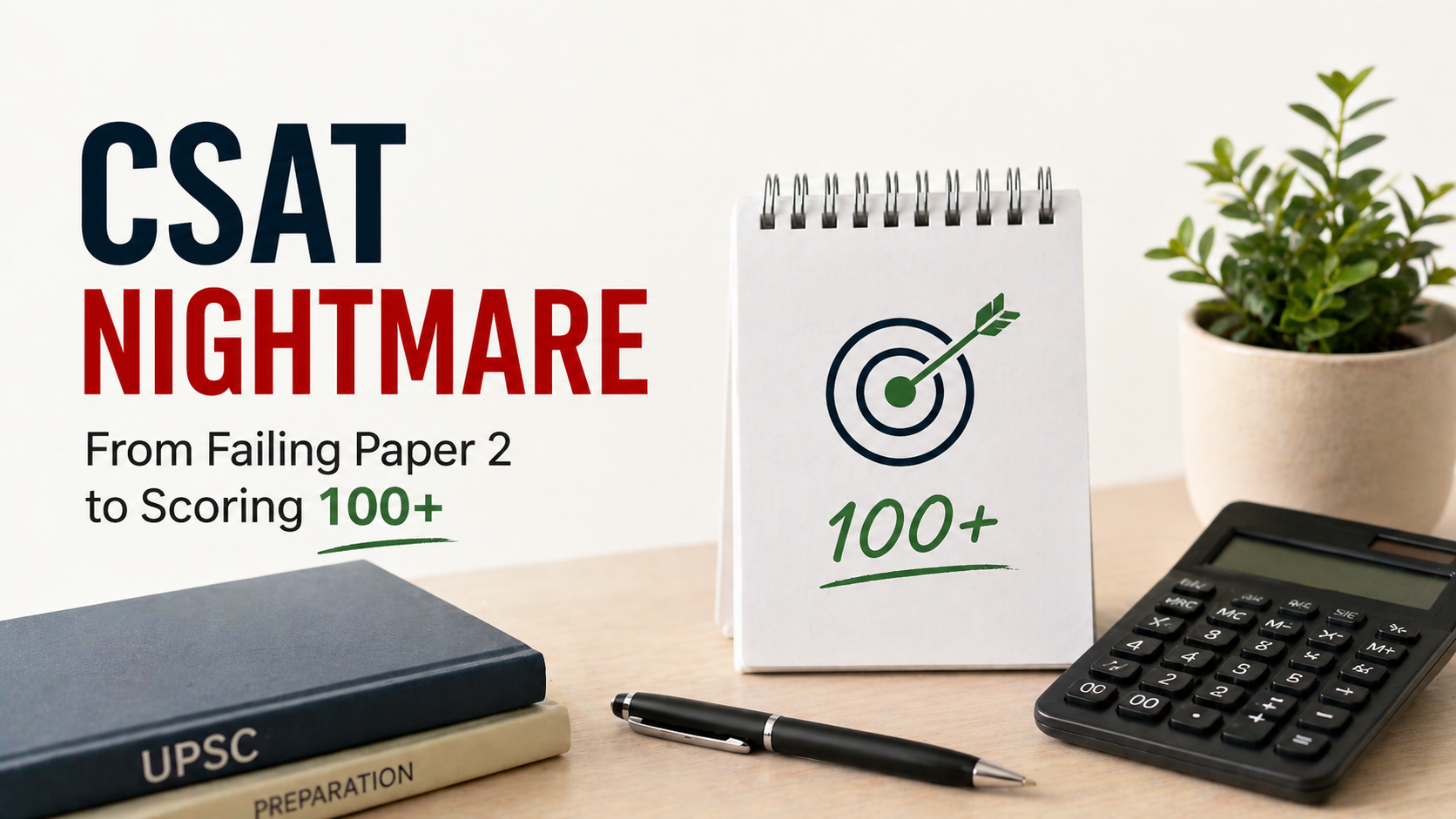
When I first started preparing for CSAT, I made the same mistake that many aspirants make. I assumed Paper 2 would take care of itself. Since it is qualifying in nature, I believed basic familiarity with comprehension and a little arithmetic would be enough. That assumption stayed with me until the day I attempted my first full-length CSAT mock test and failed to even cross the qualifying mark. That result forced me to take Paper 2 seriously for the first time.
What surprised me most was not that the paper was difficult, but that I had completely misunderstood its nature. I had treated CSAT like a formality, while the exam demanded consistency, clarity, and calm problem-solving under time pressure. My reading speed was slow, my accuracy in logical reasoning was inconsistent, and even simple quantitative questions started consuming more time than they should have. It became clear to me that ignoring CSAT was not just risky—it was dangerous.
Instead of reacting with panic, I decided to understand where exactly I was losing marks. I reviewed my mock paper carefully and noticed a pattern. I was not failing because questions were too advanced; I was failing because my basics were weak and my approach was unstructured. I was attempting questions randomly instead of selecting the ones I could solve quickly and confidently. That realization changed the direction of my preparation.
The first step I took was to simplify my strategy. I stopped searching for advanced problem-solving tricks and instead focused on strengthening fundamental concepts in arithmetic. Topics like percentages, ratios, averages, and time and work began to feel manageable once I practiced them slowly and regularly. I did not try to master everything at once. I chose one topic at a time and stayed with it until I could solve questions comfortably without hesitation.
Comprehension passages were another area where I was losing marks unnecessarily. Initially, I used to read passages quickly just to save time, but that only increased my mistakes. Later, I shifted to reading more carefully and answering fewer questions with higher accuracy. That small change improved both my confidence and my score. I realized that in CSAT, accuracy often matters more than speed.
Logical reasoning was the section that started helping me recover marks faster than I expected. Once I began practicing puzzles, seating arrangements, and analytical reasoning regularly, I noticed that my thinking became sharper. Instead of feeling stuck in the middle of questions, I started recognizing patterns more quickly. This improvement made a big difference during mock tests because reasoning questions often require clarity rather than memorization.
Another change that helped me significantly was learning to choose questions wisely during practice. Earlier, I used to attempt questions in the order they appeared. Later, I began scanning the paper first and selecting the questions that matched my strengths. This simple adjustment reduced pressure and helped me maintain steady momentum throughout the test.
Mock tests played an important role in my improvement, but only after I started analyzing them properly. In the beginning, I used to look only at my final score. Later, I began reviewing every mistake carefully and understanding why I made it. Sometimes the issue was calculation speed, sometimes it was misreading the question, and sometimes it was unnecessary overconfidence. Each mistake became a small lesson that helped me improve in the next attempt.
What surprised me most during this phase was how quickly my confidence started returning once my preparation became structured. Instead of feeling anxious about crossing the qualifying mark, I began aiming for consistency. My scores gradually moved from failing range to safe range, and eventually to a point where crossing 100 marks started feeling realistic rather than impossible.
One habit that helped me more than I expected was practicing mental calculations daily. Even five to ten minutes of basic arithmetic practice improved my speed noticeably. Over time, calculations that once felt slow began happening almost automatically. That reduced the time I spent on quantitative questions and allowed me to focus more carefully on comprehension and reasoning.
Looking back, I realize that the biggest shift in my preparation was not learning difficult mathematics but learning to respect the exam. CSAT does not require advanced formulas or complex techniques. It requires clarity in basics, regular practice, and the ability to stay calm while solving questions under time pressure. Once I accepted that, preparation became much simpler.
Reaching a point where scoring 100+ marks felt comfortable did not happen suddenly. It happened gradually through small improvements in reading accuracy, arithmetic confidence, and smarter question selection. Each mock test became less stressful and more predictable. Instead of worrying about qualifying, I started seeing CSAT as a scoring opportunity that supported my overall preparation.
If there is one lesson I carry from this experience, it is that ignoring Paper 2 is never a safe strategy, even for aspirants who feel comfortable with basic math. With a structured approach, consistent practice, and attention to mistakes, CSAT can shift from being a nightmare to becoming one of the most manageable parts of the UPSC exam. For me, that shift made preparation feel more balanced and far less uncertain than it did in the beginning.